


Second-hand HVC-2700DA Optical Coating Machine, Ion Evaporation Plating Machine, Shoe Label Vacuum Coating Machine, PVC Nano Coating Machine, AR High-Transmittance Film Coating Machine
Contact Info
- Add:Room 101, Building 5, No. 186 Zenglu Road, Chashan Town, Dongguan City, Zip: 523380
- Contact: 杨肖梅
- Tel:0769-23105805
- Email:2531943211@qq.com
Other Products


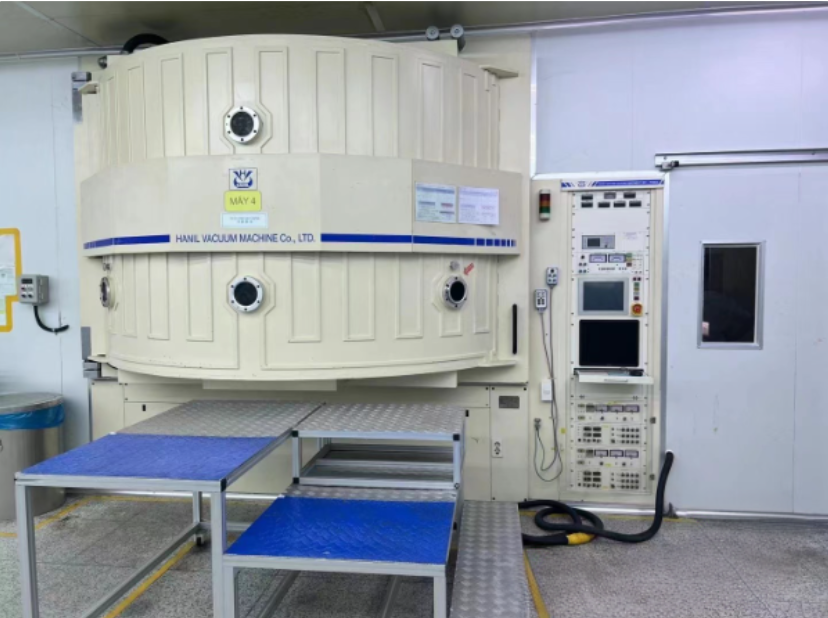
For Sale Hanyoung HVC-2700DA Optical Coating Machine Electron Beam Evaporation Plating Machine Shoe Mark Vacuum Coating Machine PVC Nano Coating Machine AR High-Transmittance Coating Machine
I. Detailed Introduction:
NO 2016-2018
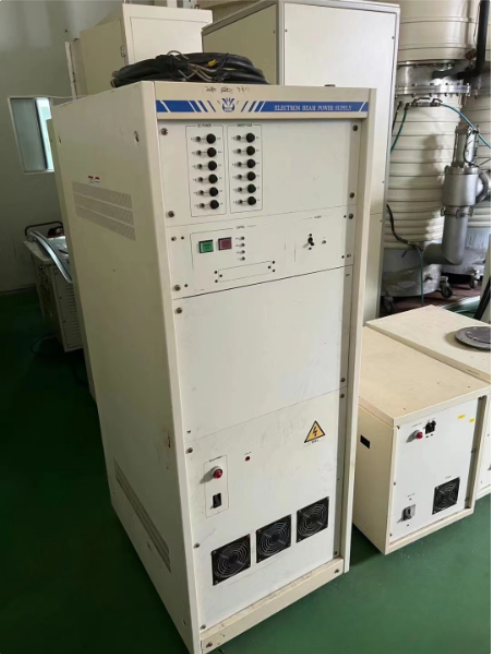
EB (Electron Gun) 1 GUN. Hanyoung 126
Higher Source Hanyoung. (Hall)
Mechanical Pump Edwards EM275
Roots Pump Edwards EM2600
Cryopump Korea V-PLUS1000H
Thickness Monitor XTC + 2 Thickness Monitors
Resistance Evaporation 1 unit
II,Coating Machine Operation Steps
Turn on the main switch, including the cooling water switch and the machine switch.
Turn on the coating machine's main switch, sample rotation switch, and lifting switch button.
Place the glass substrate in the sample holder with the conductive side facing down.
Vent the evaporation chamber and pre-treatment chamber.
Open the gate valve between the evaporation chamber and the pre-treatment chamber (clockwise to close, counterclockwise to open), push the transfer rod into the large vacuum chamber, place the sample on the transfer rod, and pull the transfer rod back into the pre-treatment chamber. Close the gate valve (clockwise to close, counterclockwise to open).
@13723521401
III, Applicable Fields

Customer Satisfaction First HVC-2700DA
Durability
Adopts advanced design techniques to prevent cracks in the Chamber and Door, featuring a sturdy door.
Ensures Film Uniformity and Repeatability
Uses variable correction plates according to the evaporation characteristics of materials to ensure uniformity across the entire dome, with no variation in quality between batches.
Simplicity
Even inexperienced operators can use it; it allows control of items according to user requirements and displays the cause and solution when a fault occurs.
Provides Process Management
Offers Process recipe and Data Logging, making it easy to manage processes and quality.
Supports Mass Production
Thorough acceptance according to standards; delivered equipment reflects customer requirements, enabling mass production shortly after installation.
I, Main Technical Specifications:
UPS RF source, precise control, single gun, optical thickness monitor monitoring wavelength range: 400-1100nm, wavelength accuracy: <±1nm, equipped with ion source, uniform ion current density distribution; maximum substrate heating temperature: 300°C. Currently depositable materials include: SiO2, TiO2, Ta2O5, Nb2O5, Al2O3, etc. Evaporation rate 0.5A/s-20A/s, working vacuum: 5E-6mbar, gases (Ar, O2)
V, Main Functions:
Mainly used for optical anti-reflection coatings, high-reflection coatings, cutoff filters, narrowband, ultra-narrowband, and extremely narrowband filters in the visible to short-wave infrared range. Equipped with two electron guns and a plasma-assisted source, capable of coating multiple samples of different sizes (1 inch, 2 inch, 3 inch, 4 inch, 5 inch, 6 inch, 8 inch, 40mm*40mm, etc.) in one run.
VI, Principle of Vacuum Evaporation Coating
1.1Place the coating material in the vacuum coating chamber and heat it to evaporate via the evaporation source. When the mean free path of the evaporated molecules is greater than the linear dimensions between the evaporation source and the substrate, the evaporated particles escape from the evaporation source surface and, while flying toward the substrate surface, encounter little obstruction from collisions with other particles (mainly residual gas molecules), directly reaching the substrate surface to condense and form a thin film.
1.2 Characteristics of Vacuum Coating
Advantages of vacuum evaporation: relatively simple equipment, easy operation; high purity and quality of produced films, thickness can be accurately controlled; fast deposition rate, high efficiency; simple film growth mechanism.
Disadvantages: difficulty in obtaining crystalline films; poor adhesion of the formed film to the substrate; insufficient process repeatability, etc.
2 Vacuum Sputtering Coating
2.1 Mechanism of Sputtering Coating
Sputtering refers to the phenomenon where energetic particles (usually positive ions of inert gases) bombard a solid (referred to as the target) surface, causing atoms (or molecules) on the target surface to escape. The mechanism of sputtering is the process of momentum transfer from the colliding particles (positive ions) to the crystal lattice particles. As shown in Figure 2, the kinetic energy transfer of the incident ions is a process of successive transfer from one atom to another.
2.2 Characteristics of Vacuum Sputtered Films
① Good controllability and repeatability of film thickness
Controlling the film thickness to a predetermined value is called thickness controllability. The ability to repeatedly achieve the desired film thickness is called thickness repeatability. In vacuum sputtering coating, film thickness can be controlled by adjusting the target current.
② Strong adhesion between the film and the substrate
Sputtered atoms have energy 1-2 orders of magnitude higher than evaporated atoms. The high-energy sputtered atoms deposited on the substrate undergo much higher energy conversion than evaporated atoms, generating higher energy and enhancing the adhesion between the sputtered atoms and the substrate.
③ When preparing alloy films and compound films, the composition of the target material is very close to that of the film material deposited on the substrate.
④ Can prepare new material films different from the target material
If reactive gas is introduced during sputtering to chemically react with the target material, a new material film completely different from the target can be obtained.
⑤ High purity and quality of the film layer
The sputtering method does not have the crucible components found in evaporation coating devices, so the sputtering coating does not mix with the crucible heater material, resulting in higher purity.
Disadvantages of the sputtering coating method: lower deposition rate compared to evaporation coating, higher substrate temperature, susceptibility to impurity gases, and more complex device structure.
3 Vacuum Ion Coating
3.1 Principle of Vacuum Ion Coating
Vacuum ion coating refers to the process in a vacuum atmosphere where an evaporation source or sputtering target is used to evaporate or sputter the coating material. A portion of the evaporated or sputtered particles are ionized into metal ions in the gas discharge space, and these particles are deposited onto the substrate under the action of an electric field to form a thin film. The principle is shown in Figure 3. First, the coating chamber pressure is evacuated to below 10^-3 Pa, then working gas is introduced to increase the pressure to 10^0-10^-1 Pa, and high voltage is applied. Since the evaporation source as the cathode is grounded and the substrate is connected to an adjustable negative bias voltage, a low-pressure gas discharge low-temperature plasma region is established between the evaporation source and the substrate. The resistance-heated evaporation source heats the coating material, and the neutral atoms escaping from the material surface pass through the plasma during migration to the substrate. Some atoms are ionized into positive ions due to collisions with electrons, while others can generate ions through charge exchange with ions in the working gas. These ions are accelerated by the electric field and射向 the negatively biased substrate, forming a thin film.
3.2 Characteristics of Vacuum Ion Coating
① Strong film/substrate adhesion, the film layer is not easy to fall off; ② Ion plating has good throwing power, improving film coverage; ③ High coating quality; ④ High deposition rate, fast film formation, capable of preparing thick films up to 30 micrometers; ⑤ Wide range of applicable substrate materials and coating materials.
4 Chemical Vapor Deposition (CVD)
Chemical Vapor Deposition technology, abbreviated as CVD technology. It is a film-forming technology that uses heating, plasma enhancement, light assistance, and other means at atmospheric or low pressure to cause gaseous substances to undergo chemical reactions on the substrate surface to form solid thin films.
CVD technology generally has the following characteristics:
① Equipment and process operations are relatively simple, flexible, capable of preparing single or composite films with various ratios and composite layers;
② CVD method has wide applicability;
③ Deposition rate can be as high as several micrometers to hundreds of micrometers per minute, resulting in high production efficiency;
④ Compared with PVD methods (evaporation, sputtering), it has good throwing power, suitable for coating complex-shaped substrates;
⑤ Good coating density;
⑥ Low damage after exposure to radiation, and can be integrated with MOS integrated circuit (an integrated circuit mainly composed of metal-oxide-semiconductor field-effect transistors) processes.
5 Summary
Vacuum coating technology mainly includes physical vapor deposition (PVD) technology and chemical vapor deposition (CVD) technology.
The evaporation, sputtering, and ion plating mentioned above belong to PVD, and their basic principles can be summarized as: vaporization of coating material → migration of coating atoms, molecules, or ions → deposition of coating atoms, molecules, or ions on the substrate.
Chemical vapor deposition can be summarized as: formation of volatile substances → transfer of these substances to the deposition area → chemical reaction on the solid to produce solid material.
After-Sales Service:
Includes on-site installation and调试, warranty for3 months
Details Manager Yang 13723521401 18103045976

| Industry Category | Chemicals/Amines/Cyclohexylamine |
|---|---|
| Product Category | |
| Brand: | 韩一 |
| Spec: | HVC-2700 |
| Stock: | 1 |
| Manufacturer: | 韩一 |
| Origin: | 114419 |


